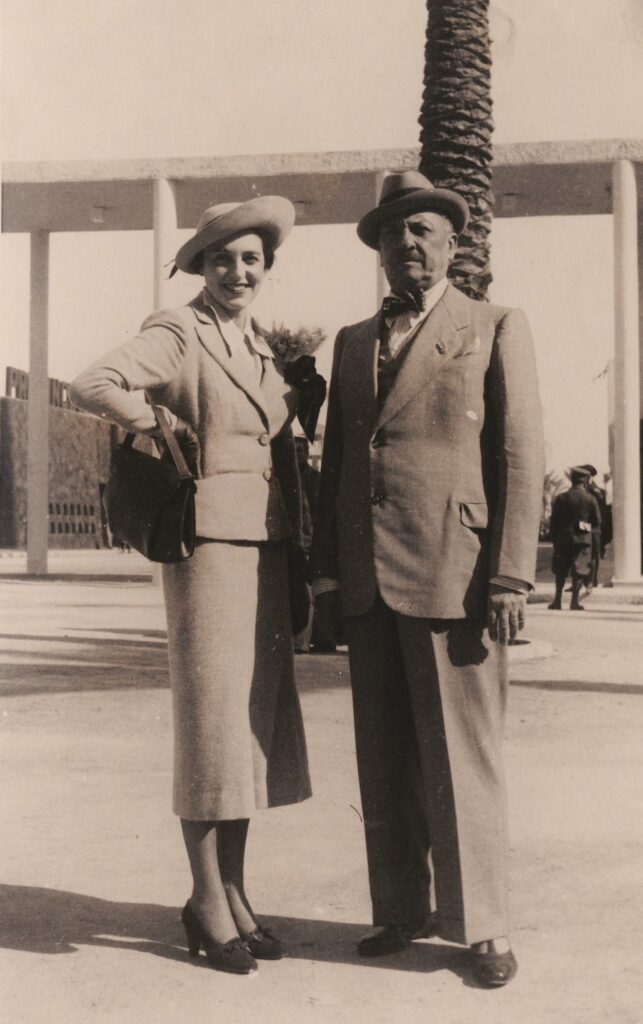
Behind the simple signature ‘Benedetta’ lies one of the most interesting figures of Italian Futurism. Benedetta Cappa Marinetti (Rome 1897-Venice 1977) chose to be known only by her first name, as was customary among many Futurist artists, who were fascinated by the idea of creating an artistic gesture even in their own identity.
Unlike others, Benedetta was not born into an artistic family, but became involved in the art world by becoming the life and artistic partner of Filippo Tommaso Marinetti, founder of Futurism. There is no point in hiding it: her entry into the movement owes much to her husband’s fame, but he never failed to support and recognise her. Indeed, it was Marinetti himself who often said, in his usual triumphant tone: “Her genius is equal to mine”.
Curiously, while Futurist manifestos abound with expressions of contempt for women, in practice things were different. In fact, there was no shortage of female Futurists, who were numerous and active. The rejection of the traditional female figure – the idealised, angelic figure celebrated in romantic poetry or the “Dolce Stil Novo” – did not coincide with the exclusion of women from the movement. On the contrary, there was a real revolution compared to the past.
Suffice it to say that, in the 19th century, even an artist like Renoir declared in no uncertain terms: ‘The female artist is ridiculous. I prefer her as a singer or dancer. “ Futurism overturns this prejudice. It is true that it rejects the ‘eternally feminine” view of women, but it does so because it wants to break down preconceived roles, not because it intends to deny women access to art.
However, this new image of women generates contradictions. If all women must take on “masculine” characteristics in order to assert themselves, then who will take care of procreation and the education of children? The answer, in the bourgeois context, seems obvious: proletarian women will be employed as nannies, wet nurses and midwives. But this risks creating a new inequality between professionally “fulfilled” women and “second-class” women, relegated to the role of mothers and housewives.
It is no coincidence that Popes Pius XI and Pius XII – even more conservative than the fascist regime – saw the growing emancipation of women as a threat to the social order. They sensed that the imposition of a new dominant model of womanhood – active, working, independent – did not eradicate inequality, but merely shifted it. Today, we see this clearly: a woman who freely chooses to devote herself to her family risks being judged a “failure” or a “kept woman”. What was once a right (access to education and work) has become a social obligation.
Returning to Futurism, the rejection of traditional images of women – the muse, the angel of the hearth, Beatrice – should be read in this light: not so much as pure misogyny, but as a rejection of a poetic and social model now considered obsolete. And there are many Futurist women. To name just a few Italian ones: Adrì (Adriana Fabbri), Luce and Elica Balla (daughters of the famous painter Giacomo Balla), Olga Biglieri, Brunas (Bruna Pestagalli), Regina Cassolo, Leandra Angelucci Cominazzi, Alma Fidora, Adele Gloria. Of all of them, Benedetta is certainly the best known. Her connection with Marinetti certainly played a role, it is true. But it would be reductive to consider her simply a “recommendation”. Her talent was evident from the outset: in 1924, she published the novel Le forze umane (Human Forces). An abstract novel with graphic summaries, it was an experimental work in perfect “parolibero” style, blending writing and graphics. As a painter, she exhibited at the Venice Biennale as early as 1926 with the works Velocità di motoscafo (Speedboat Speed) and Rumori di treno notturno (Noises of a Night Train), also participating in the 1930, 1932 and 1934 editions. She also worked in theatre set design, collaborating with Enrico Prampolini and Marinetti himself, with whom she signed the Manifesto dell’Aeropittura futurista (Manifesto of Futurist Aeropainting) in 1929. Other signatories included Giacomo Balla and Fortunato Depero, promoters of a style of painting inspired by speed and aerial perspectives. One of her most important works can be found in the Palazzo delle Poste in Palermo, designed by the Futurist architect Angelo Mazzoni: in the conference room, Benedetta created five large panels celebrating rail, sea and air communications. In 1944, Marinetti died in the war, having enlisted as a volunteer despite his age. Benedetta continued to paint and promote Futurist art around the world until her death.
A life dedicated to art and experimentation, alongside a man who was difficult but whom she sincerely admired. And who knows, perhaps even today, in some corner of history, Filippo Tommaso Marinetti would look at Benedetta with pride, certain that Futurism would not have been the same without her.
Lascia un commento